
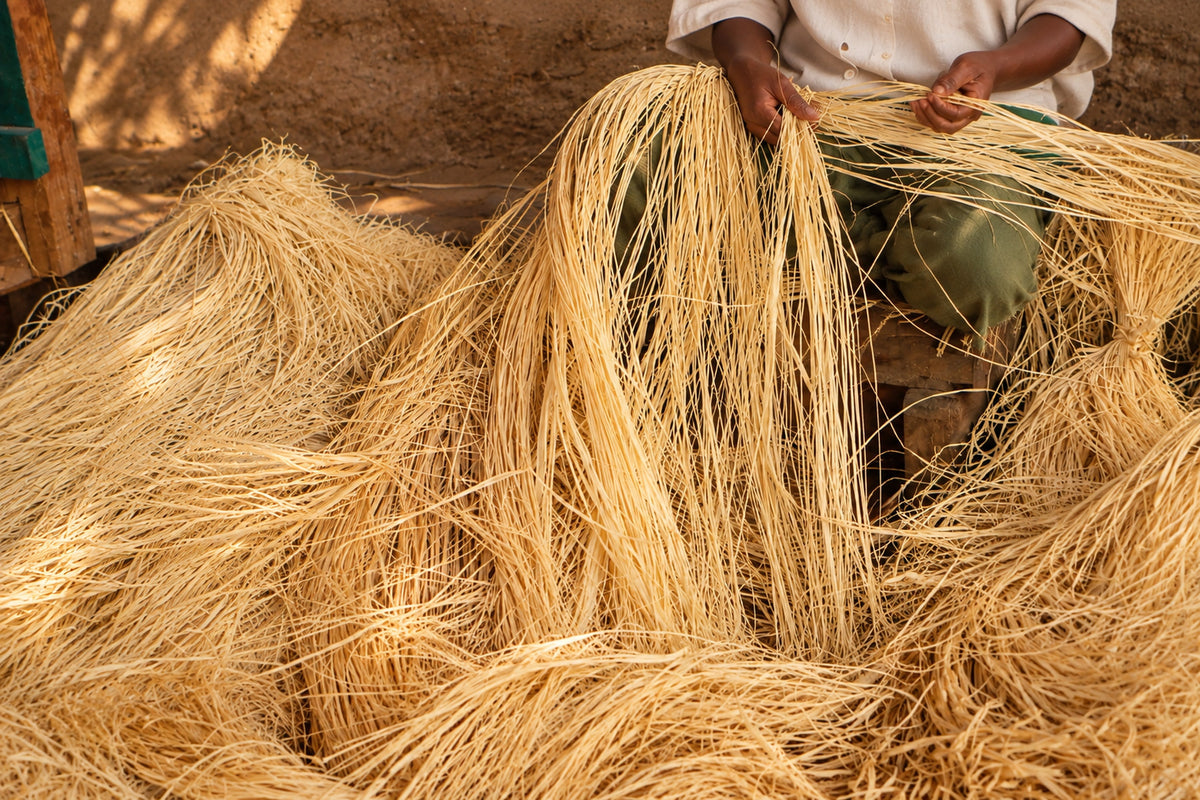
A Madagascar raffia bag is a bag woven or crocheted by hand from raffia fibre, a plant native to the island. At mada, the raffia comes from plantations in the Mahajanga region, and every bag is made by hand in our workshop near Antsirabe, where 12 artisans work.
where does the raffia in our bags come from?
Madagascar is the world's leading producer of raffia. The plant fibre is taken from the leaves of the raffia palm, which grows mainly in the island's humid regions. Ours comes from plantations in the Mahajanga region, in north-west Madagascar.
We then dye the raffia ourselves, through successive soakings, until the colour gets into the fibre instead of sitting on the surface. That is where the bright colours of our models come from, before the raffia is crocheted by hand.
who makes mada bags, and where?
Our bags are made by hand in a workshop near Antsirabe, in Madagascar's central highlands. Twelve artisans work there: raffia crochet, leatherwork for the leather finishes, and quality control of both the raffia and the finishing.
Each piece takes between 19 and 26 hours of work depending on the model: 19 hours for le rond, 20 for the capsule rond, 22 for le bowling, 26 for le demi-lune. That time, and the number of hands each bag passes through, is what explains the small irregularities of a handmade object.
raffia and leather: how are the two materials combined?
Le demi-lune and le bowling combine raffia with leather handles, and the capsule rond with a leather finishing detail. The classic rond is almost entirely raffia: the only leather is a small piece on the inside pocket. All our bags are lined.
The leather we use is vegetable-tanned shoulder leather of French origin, finished in a tannery in the Vosges. Our leathers comply with the REACH regulation. Its warm tones balance the bright colours of the raffia, and it takes care of the areas that work hardest: the handles and the points where they attach. More on this in raffia and leather bags: why shoulder leather.
what sets a mada bag apart from a generic raffia bag
On most raffia bags sold online, the origin of the fibre is rarely stated, production is often subcontracted without saying where, and any leather is left undescribed. At mada, every step is named: the raffia comes from the Mahajanga region, it is dyed by us and crocheted in a single workshop near Antsirabe by 12 artisans, and the leather comes from an identified French tannery. How the artisans are paid is also disclosed, which is still rare in the industry.
how to choose a Madagascar raffia bag
Three questions are enough to find your way. The first is about material: a bag that is almost all raffia, such as le rond, is lighter, while a bag that combines raffia and leather, such as le demi-lune or le bowling, holds its shape better. The second is about use: a short handle for a bag carried by hand, a long adjustable strap for a bag worn crossbody or on the shoulder. The third, often overlooked, is about the inside: a 100% cotton lining and a zipped pocket make a real difference day to day.
how long does a raffia bag last?
There is no single lifespan that applies to every bag. Raffia is a natural fibre, so the bag changes over time: its colour fades little by little and a few strands may stick out or break with use, sometimes within the first years. The right care (away from water and direct sun, stored in its dust bag) slows this wear, and strands that stick out can be trimmed with a pair of fine scissors. We cover this in detail in the article how long does a raffia bag last and in our care guide.
what mada does differently
Our artisans are paid three times what they would earn elsewhere for equivalent work. They have health cover and a retirement contribution, and we pay their children's school fees. These are concrete actions, not yet a structured social fund: we talk about it openly on our Our actions page and in the article a bag that changes lives.
frequently asked questions
is raffia a durable material?
Yes, it is a strong plant fibre that has long been used in basketry and leather goods. It simply needs to be kept away from prolonged humidity and direct sun.
can a raffia bag get wet?
Best avoided. After rain or a stain, a gentle wipe with a soft, slightly damp cloth is enough, without soaking the bag.
is raffia a natural material?
Yes, raffia is a plant fibre taken from the leaves of the raffia palm, with no heavy chemical processing.
what is the difference between le rond, le demi-lune and le bowling?
Le rond is the most minimal: almost entirely raffia, with just a little leather on the inside pocket. Le demi-lune pairs raffia with a leather handle for a more polished look. Le bowling has a small leather handle and a long adjustable strap, for more versatile use.
how long does it take to make a mada bag?
Between 19 and 26 hours depending on the model, from the raffia crochet to the leatherwork.
where are the bags made?
In our workshop near Antsirabe, Madagascar, by a team of 12 artisans.
mada social bags, updated October 2026.