
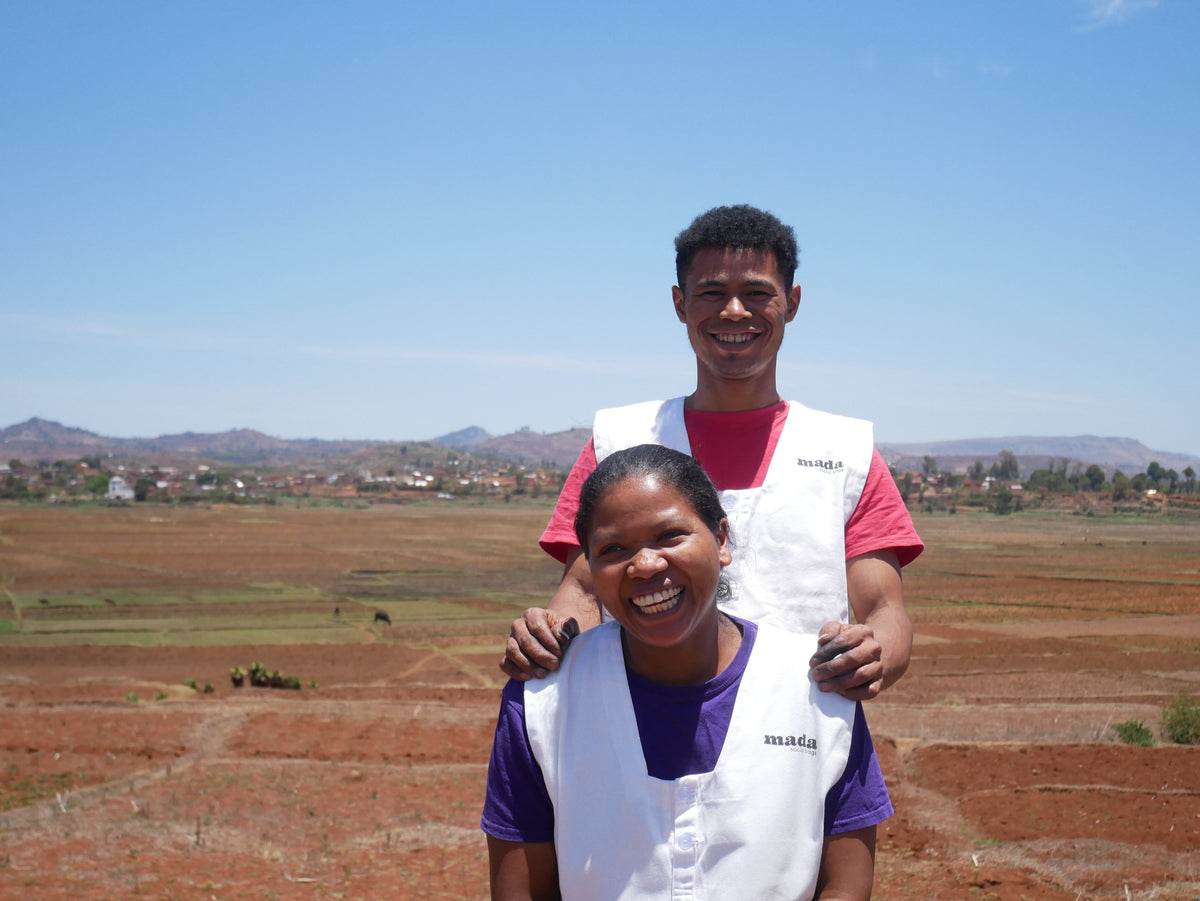
A mada social bags piece funds a specific employment model, not a vague good intention: our 12 artisans, in our workshop near Antsirabe, are paid three times what they would earn elsewhere for equivalent work, with health cover, a retirement contribution, and their children's schooling and school fees paid for. Each of these choices answers a specific need, not a box to tick on a CSR charter.
Pay you can build a life on, not just get by
Paying three times what someone would earn elsewhere for the same work is not a symbolic gesture: it is the difference between an income that covers the current month and one that lets you save, make plans, and not be one setback away from hardship. It is also a way of recognising what a bag really takes: between 19 and 26 hours of work depending on the model, and a skill that only comes with years of practice.
Why health cover is not an extra
In Madagascar, access to healthcare remains particularly limited in rural areas: there are few health facilities, and for many families a consultation or treatment is an expense put off for as long as possible. Health cover for our artisans is therefore not a comfortable perk, it takes the question of whether you can afford to get treatment out of the equation.
Retirement, a safety net that barely exists in this context
Very few people in Madagascar have access to a pension: in practice, most people work their whole lives, with nothing to take over when their body can no longer keep up. Contributing to a retirement fund for our artisans means recognising that the skill we value today has a physical end date, and that this should not mean an income that stops overnight.
Children's schooling: a cost that lands at the worst time
School fees have one particularity: they are significant, one-off expenses that fall at fixed points in the year, regardless of how much money came in that month. On an irregular income, this kind of cost is often what forces a family into a difficult choice between a child's education and another essential expense. Paying for the schooling and school fees of our artisans' children removes exactly that tipping point.
What we don't claim to be yet
We do not have a structured social fund, financed by our profits, with formal allocation rules. What we have are these four concrete actions, put in place at the pace of our business. We would rather say so clearly than present it as further along than it is: the ambition of a social fund exists, but it will be built as the brand grows, not before.
Frequently asked questions
Will the workshop take on more artisans in the future?
That is the goal, at the pace of our business: we would rather grow gradually and guarantee the same conditions to every new person than speed up at the expense of what we have already put in place.
How can you be sure these commitments are real and not just for show?
Pay, health cover and school fees are concrete expenses for the business, not empty promises: we would rather document precisely what we do than announce something bigger.
Does the price of a bag reflect this social commitment?
Partly: the price mainly reflects the making time and fair pay for the work involved. The social commitment is not a cost added on top, it is part of how pay is structured in the first place.
Why not announce a specific percentage of profits given back?
Because we do not yet have a social fund structured that way: we would rather be honest about it than display a figure that does not correspond to anything concrete today.
mada social bags, updated September 2026.