
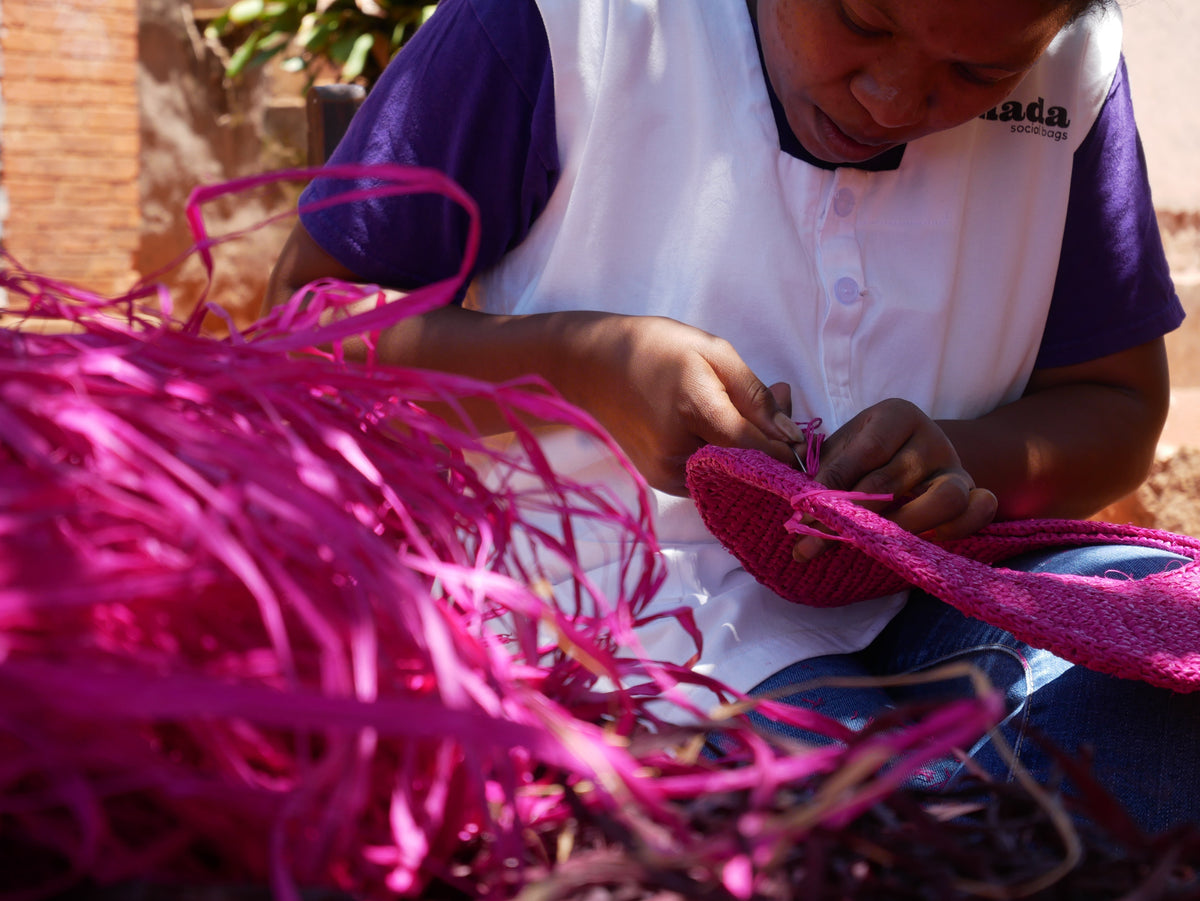
A mada social bags piece starts with raffia from plantations in the Mahajanga region and is finished after 19 to 26 hours of handwork in our workshop near Antsirabe. In between, almost nothing is mechanised: dyeing, crochet and leatherwork are all done by hand, because each of these steps calls for decisions that only an experienced hand can make at the right moment.
Where the raffia we work with comes from
Our raffia comes from plantations in the Mahajanga region, in north-west Madagascar. The fibre is taken from the young leaves of the raffia palm, whose outer skin is stripped and then dried. It is an unusual plant: it flowers only once in its life, at around twenty years old. That fibre is where our work begins.
Dyeing, done by us
We dye the raffia ourselves, through successive soakings: the fibre goes into the dye bath, is dried, then goes back in, as many times as it takes for the colour to get into the material instead of sitting on the surface. That is what gives our models their bright colours, from green to purple by way of orange, and it is also why two batches of raffia never come out quite the same shade. This step is not timed with a stopwatch: it is judged by eye.
Crochet, stitch by stitch
The heart of the work is hand crochet, a traditional technique often passed down from mother to daughter in Madagascar. The hook builds the bag stitch by stitch, giving each row the tension that will hold the shape: too loose and the bag sags; too tight and the fibre becomes hard to work and the bag loses its suppleness. On models that combine raffia and leather, the workshop's leatherworker then steps in to fit the handles and leather finishes, in the places that take the most strain.
What cannot be rushed without losing quality
Depending on the model, a bag takes between 19 and 26 hours of work, from the first stitch to final assembly. It is not a figure you could cut by streamlining the gesture: the density of the crochet depends precisely on the time taken to tighten each strand. Going faster mechanically loosens the tension, and so makes a weaker bag. In our workshop near Antsirabe, our 12 artisans have made the opposite choice: taking the time the material needs, not the time a production target would impose.
The result: an object that exists only once
Raffia has a natural irregularity: no two strands are ever exactly alike, which means two bags of the same model, crocheted by the same person, never look quite the same. It is not a manufacturing defect, it is the direct result of handwork on a living material rather than a calibrated industrial yarn. Buying a mada social bags piece also means accepting that slight variation as a quality rather than an imperfection to correct.
Frequently asked questions
Where does mada's raffia come from?
From plantations in the Mahajanga region, in north-west Madagascar. The dyeing and making are then done by us, through to assembly in our workshop near Antsirabe.
Is raffia crochet quick to learn?
No: keeping an even tension row after row, over the full height of a bag, takes repeated practice. It is a skill traditionally passed down from mother to daughter rather than taught in a few sessions.
Why can the colour of a raffia bag vary slightly from one piece to another?
Because we dye the raffia ourselves through successive soakings, and this process never gives exactly the same result from one batch of fibre to the next. It is a consequence of hand dyeing, not a flaw.
Is crochet different from the weaving used for other raffia objects?
Yes: crochet is done with a hook, stitch by stitch, which makes it possible to build three-dimensional shapes like our bags. Other raffia objects, such as mats or rabane cloth, are woven on a loom: a more regular technique, but one that produces flat surfaces.
mada social bags, updated September 2026.